Spray Booth Gallery
Circa 2011-2013
This was the website for Spray Booth Gallery, an artist run art space located in the Crossroads Art District.
Sadly the Spray Booth Gallery has since closed.
Content is from the site's 2011-2013 archived pages and other relevant outside sources offering just a glimpse of what this gallery was all about.
~~~~~
As an architectural staging consultant, I’m always studying how space tells a story—through light, sightlines, texture, and proportion. Visiting Spray Booth Gallery in Kansas City’s Crossroads Art District left a lasting impression on me. It wasn’t just an artist-run space; it was a gallery that truly understood how architecture and art interact.
What stood out most was how each exhibition seemed to reinvent the room. The installations felt intentional—clean sightlines, thoughtful spacing between works, and lighting that enhanced mood without overpowering the art. Shows featuring emerging artists like Molly Kaderka demonstrated how carefully staged walls and negative space can heighten emotional tension and draw viewers deeper into the work.
Recently, I had the privilege of meeting one of my heroes, architectural photographer Rue Sakayama. Watching her work has been transformative. She has an extraordinary ability to turn indoor and outdoor spaces into stunning compositions through sophisticated lighting and precise camera placement. She doesn’t just photograph architecture—she reveals its essence.
Spending time observing her process has sharpened my own practice. I now think more intentionally about how a staged space will translate through the lens—how light falls across surfaces, how angles affect scale, and how subtle adjustments can elevate an entire composition. I’m learning so much just by watching her refine exposure, balance ambient light, and frame a shot with patience and precision.
Spray Booth Gallery may no longer be open, but its spirit of experimentation and spatial awareness continues to inspire me. Combined with the lessons I’m absorbing from Rue, it’s reinforced my belief that great staging—and great photography—both begin with honoring the inherent beauty of a space and knowing how to let it shine. Ruth Rayner
~~~~~
2011-2013 Spray Booth Gallery
130 W 18th Wyandotte St.
OR 18th & Wyandotte St.
Kansas City, MO 64108
Hours
Monday: CLOSED
Tue-Fri 12:00pm-6:00pm
Saturday 10:00am – 3:00pm
Sunday: CLOSED
Monthly exhibitions, public art initiative, supports both risk and dialogue by exhibiting new works from young and emerging artist.
2012 Kickstarter
Funds from this Kickstarter will support our programming budget for the 2012 year, enabling monthly exhibitions and thematic shows planned, as well as exchanges/collaborations with other artist-run spaces and arts publications across the country.
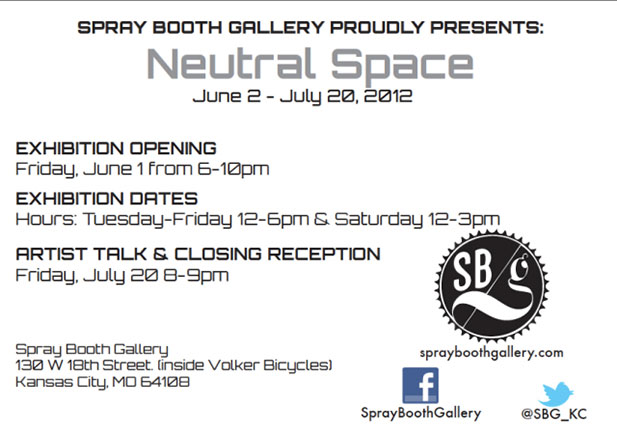
- A featuring thematic exhibition called Neutral Space, will take place on May 4th First Friday themed afterthe grid. Neil Thrun will be writing about the historical background of the grid, also the context of how the various artists in the show are using the grid, and how the neutral gray gridded wall is painted.
- Spray Booth Gallery (SBG) plans on Bringing back the Salon Show for 2013 in February.
- For future curators that are in perspective of either exchange/collaborations or curated exhibitions for the future months to come will be done by Erin Olm-Shipman, Tracy Abeln, and Sean Starwitz. Other people have not yet been revealed but will have the same opportunities for putting on exhibitions.
- Other perspectives SBG plans on bringing to the space are Saturday afternoon talks with the featuring artist/curator that had the opening the previous night and ending receptions for featured exhibitions.
-
SBG will be brining back Sean Starwitz creation called Know Show Thursdays, a "series of talks/lectures/performances that take place in Gallery itself. Know Show consist of three 15-minute presentations in which peers teach skills that are not necessarily taught in institutional settings. The presentations are taught by individuals who have experiences within specific skills that they can teach and enjoy sharing it with others. Know Show is completely open to anyone both in presenting and in participation..." The first Know Show will begin May 17at 8:30 p.m.
WHO is SBG?
Spray Booth Gallery is an artist run art space located in the Crossroads Art District. Spray Booth is dedicated to creating community around art-based experiences that are thought provoking and conceptually rigorous, while also being accessible and fun. Through a framework of monthly exhibitions and related programs, we strive to maintain a dynamic schedule in which the gallery is continuously reinvented to reflect the spirit and process of an artist, specific program series, or a collaboration.
Change has been slow and organic with each participant leaving an indelible impression that tells the evolving story of “Spray Booth,” These participants are comprised of young and emerging artists, known and unknown nationally, affiliated musicians, artists and fellow programmers. Because programming decisions are independent of the amount of revenue the gallery generates for operational expenses, we are able to focus on hosting events that support the growing Kansas City culture.
SBG hosts experimental exhibitions, with new works from young and emerging artists that supports both risk and dialogue, and public art initiatives. SBG aims to incite conversation on contemporary art in the Kansas City area. We accomplish this through dynamic relationships between art, artist, and audiences, supporting challenging work, reflecting the diversity of the city.
We did it, Thank you!
Words alone cannot express the gratitude I feel for the success of
SBG's Kickstarter. It would not be possible without the support and generosity of all who contributed and believed in the importance of bringing art and culture to the community. So stay tuned as SBG unveils exciting educational programs and new artists in the very near future.
Spray Booth Gallery Circa 2012-2013 Posts
Lovely Lonely Exhibition : Molly Kaderka
Posted on May 2, 2013 by Andrew Lyles
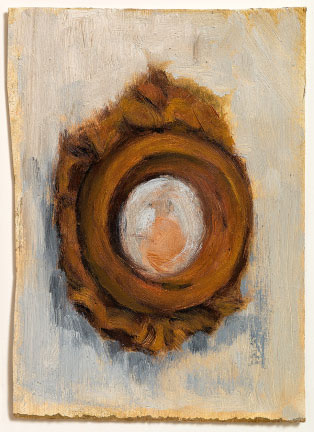
Mirror Oil Paint on Paper 2012 about 3″ x 5″ Photo credit E. G. Schempf

Clementines. 2013. Oil paint on linen. Photo by Robert Chase Heishman
The Spray Booth Gallery’s new exhibition, Lovely Lonely, debuts new paintings by emerging Kansas City artist Molly Kaderka. With these intriguing works, Kaderka continues her exploration of the figure and the spaces it inhabits. Opening May 3rd, Lovely Lonely is the second installment of what will be a two-part show of Kaderka’s recent work. Lovely Lonely was preceded by In the Frame, which ran from April 5th- May 1st.
In her paintings, Kaderka uses figures to portray complex human relationships and a range of emotional and physical paradoxes. For instance, her figures are often posed intimately and close together and yet remain isolated from one another. She also plays with the viewer’s perception of space—interrupting it with mirrors or paintings hung on the walls that depict more dimensional space than the rooms in which they are placed.
Opening tomorrow for First Friday May 3rd 6:00 – 11:00 P.M. Tell all you’r friends and family to stop by Spray Booth Gallery!
Article in The Pitch on Molly Kaderka!
Posted on April 3, 2013 by Andrew Lyles
Molly Kaderka figures out the past for her paintings
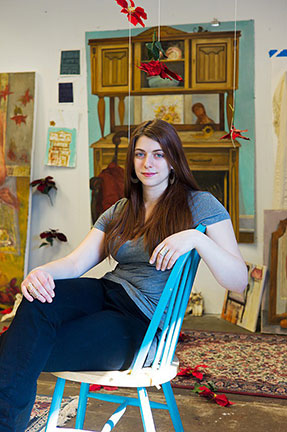
Photo by Barrett Emke of Molly Kaderka
Molly Kaderka’s mysterious, emotionally charged figurative paintings stand out in an art scene saturated with abstractions and social practices. Their fleshy figures occupy fantastic wooded landscapes or domestic interiors that resemble midtown Kansas City apartments. The Pitch stopped by Kaderka’s Urban Culture Project studio as she prepared for two exhibitions at Spray Booth Gallery, the first of which opens on First Friday. She has made this former office space her own, filling it with props (oriental rugs, cushy comforters, fake flowers) and covering the walls with what seems like an endless supply of her own paintings and drawings.
The Pitch: Why paint the figure — a subject that has been revisited for centuries — in this day and age?
Kaderka: People are always inclined to look at and empathize with images of other people. For this reason, the figure has always been relevant and will continue to be relevant. I want to make work that is relevant to my audience, and I want to engage senses and emotions that are a part of the basic human experience. For me, the figure is the most important, complex and challenging subject to work with. I always want to be functioning on the edge of my own limitations as a painter to ensure that my work is always evolving and is in danger of failing. I reach this place most often when I am working with the figure. It’s very exciting.
Is your work autobiographical?
I would say that my work is inspired by my own life, but it is not autobiographical. I paint myself as a part of my search for meaning and reflection in my own life. And I paint the people who are important to me because I want to paint things and people who I love. As for objects, I paint the things that I like, trusting that they will lead me somewhere new and interesting.
Right now you have poinsettias, animal bones and fruit in your studio as props for your paintings. What attracts you to those forms?
My work in general is about taking a look at interior emotions and bringing those emotional states to the surface through painting. Bones are, quite literally, something inside all of us. I like using bones as an object because they are a physical manifestation of something from the inside being shown on the outside.
I like and use poinsettias for the opposite reason. Where bones are rigid, linear objects with little color, poinsettias have a rich saturated color and a soft organic shape. Where bones are often used as a reminder of death, poinsettias, for me, are a bold reminder of life. Used together, these objects create a dynamic tension in the painting.
You have books in your studio open to display works by old masters, and you double majored in painting and art history at the Kansas City Art Institute. Who are some of your favorite artists?
It is my firm belief that if one is going to work within the tradition of painting, you have to know its history. This is an integrity issue for me.
My top favorite painters are Titian, Pontormo, Velasquez, Bonnard and Lucian Freud. They are all masters at creating thrilling and convincing worlds within their paintings. They are all masters of color, form, etc. But mostly, these are my favorite painters because whenever I see one of their works, the paintings speak to me and cause an emotional response.
How do those artists influence your work?
I look at these painters because they show me what can be achieved. They have all created beautiful, perfect paintings, which is a goal I want to accomplish in my lifetime. I admire them for the worlds they create, for their use of color and their ability to be so convincing.
Mannerism, a movement associated with the exaggeration of forms for emotional effect, is one term that applies to your work. Why do you choose to distort figures, objects or spaces in your paintings?
For me, composition is everything. The proportions and perspectives of figures, forms and space can always be distorted to serve a compositional purpose. A distorted figure, whether the viewer recognizes it or not, allows that image to become symbolic or even allegorical because it is not a documentation or study from life. It becomes something beyond reality, which is where meaning and truth lie. I think!
Like writing, if an image is illegible, then it cannot convey anything and is therefore meaningless. Writers have words with inherent meaning assigned to those words. Painters have brushstrokes that gain meaning by the way they are assembled.
Some areas of your paintings are rendered in more detail than others.
This is a way for me to create a compositional hierarchy. The moments in the painting that have more visual information are important moments in the narrative of the work. These moments allow me to lead my viewer’s eye around the composition.
In my work, there are multiple narratives: the narrative of the image and the narrative of the surface. The way the paint is applied tells its own story and creates a specific effect that explains and enhances the image it is describing. Ideally, the whole image is constructed under this principle: that every brushstroke has a deliberate relationship to every other brushstroke in the piece. For me, moments of touch between figures are the most important moments in my compositions. (from The Pitch).
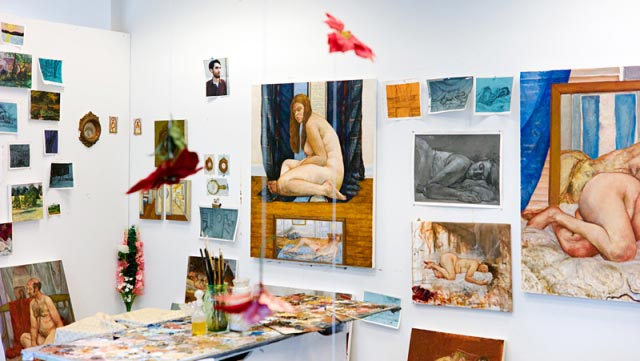
Photo By Barrett Emke. Molly’s Studio at Charlotte Street Foundation.
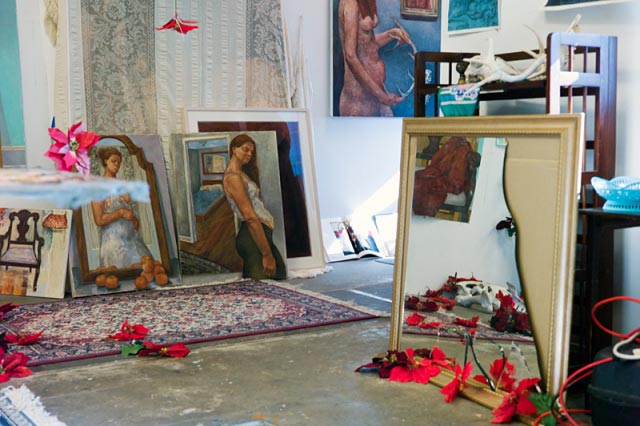
Photo By Barrett Emke. Molly’s Studio at Charlotte Street Foundation.
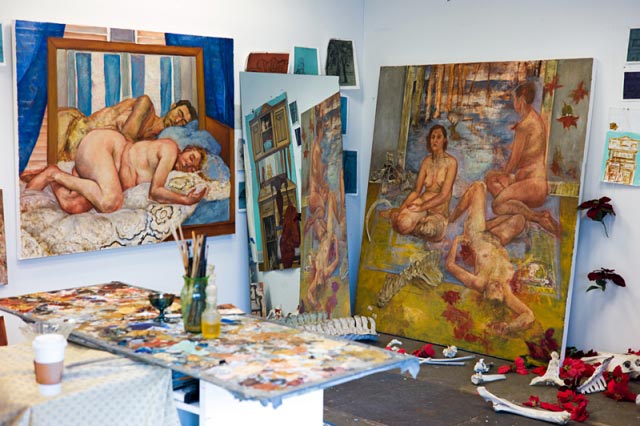
Photo By Barrett Emke. Molly’s Studio at Charlotte Street Foundation.
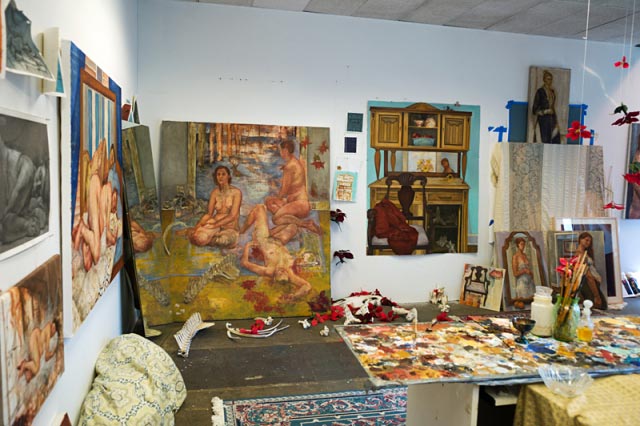
Photo By Barrett Emke. Molly’s Studio at Charlotte Street Foundation.
Molly Kaderka
Posted on March 11, 2013 by Andrew Lyles
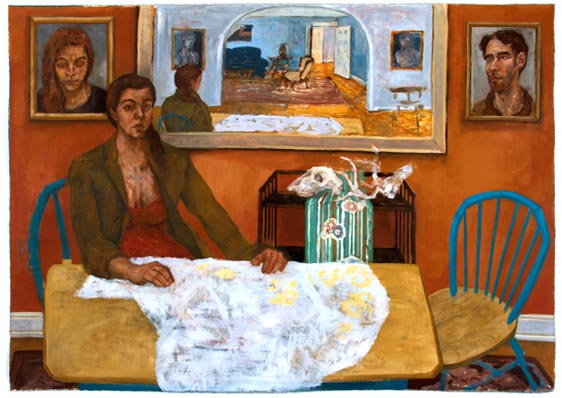
Molly Kaderka : At the Table, 2012 Oil paint on paper 50” x 72” Photo By : Robert Chase Heishman
Spray Booth Gallery presents Molly Kaderka
In the Frame April 5th
Lovely Lonely May 3rd
The Spray Booth Gallery’s new exhibition, In the Frame, debuts new paintings and drawings by emerging Kansas City artist Molly Kaderka. With these intriguing works, Kaderka continues her exploration of the figure and the spaces it inhabits. Opening April 5th, In the Frame is the first installment of what will be a two-part show of Kaderka’s recent work. It will be followed by Lovely Lonely, opening May 3rd.
In her paintings, Kaderka uses figures to portray complex human relationships and a range of emotional and physical paradoxes. For instance, her figures are often posed intimately and close together and yet remain isolated from one another. She also plays with the viewer’s perception of space—interrupting it with mirrors or paintings hung on the walls that depict more dimensional space than the rooms in which they are placed.
Kaderka makes interesting use of color and composition, such that everyday objects, like a framed picture on a wall or a blue kitchen chair, become symbolic, enigmatic, and fantastic. She adheres to the practice of perceptual painting but has an unapologetic way of distorting both form and space to create unique compositions and strangely familiar environments. Through the familiar and the strange, Kaderka seamlessly creates spaces of reflection and reverie.
Recently Kaderka has shown at the Paragraph Gallery and the Subterranean Gallery in Kansas City, the Austin Museum of Art in Austin, Texas, and the Kimball Art Center in Park City, Utah. Molly received her BFA in Painting and Art History in 2011. She is a second-year Urban Culture Project artist-in-residence and currently works for the H&R Block Artspace at the Kansas City Art Institute.
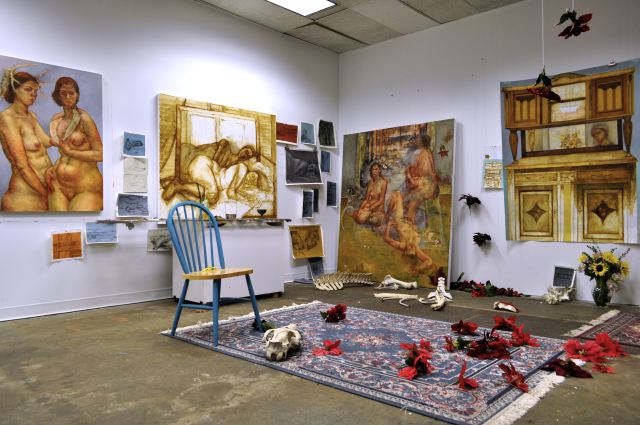
Molly Kaderka : Charlotte Street Foundation Studio. Photo by : Robert Chase Heishman
________________________________________________________________
Remember to mark your calendar for two fantastic shows!
Molly Kaderka: In the Frame, Opening April 5th First Friday 6:00 – 11:00 p.m.
Molly Kaderka: Lovely Lonely,Opening May 3rd First Friday 6:00 – 11:00 p.m.
www.mollykaderka.com
Photos by: Robert Chase Heishman
Monday: CLOSED
Tues – Fri 12:00pm-6:00pm
Saturday 11:00am – 3:00pm
Sunday: CLOSED
Appointment @ email sprayboothgallery@gmail.com
2012 POSTS
THE POWER OF 10
Posted on November 15, 2012 by Andrew Lyles
Spray Booth gets honest with Overlook
by Theresa Bembnister
Unassuming in its execution and devoid of any overarching theme, Overlook is exactly the kind of exhibition that’s easy to, well, overlook. But that would be a mistake.
Gallerist Andrew Lyles and photographer Ah-ram Park have selected 10 photographs by six local and regional artists, and their straightforward installation allows each work to make a separate case for itself. Every image here — portrait, still life, landscape and interior — holds your gaze and stands up to scrutiny.
“I simply saw a group of photographers taking really honest photographs from all walks of life,” Park says when I ask him how he and Lyles organized Overlook. The photographers (all of them men) vary in their interests, ages and levels of experience. What their works here share is that honesty, a quality essential to print photography’s enduring appeal in a digital-image-saturated age. These images each capture a scene or a moment as it occurred, as the photographer understood it, then hold it for intense observation. They aren’t Instagrams, meant to be glanced at more than examined.
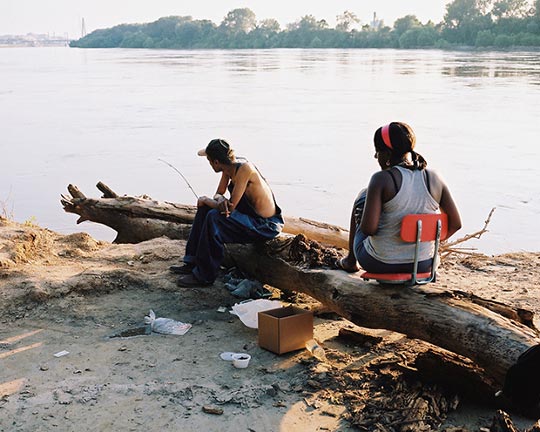
River Front Park, Kevin Sisemore
With his two photographs of Missouri River scenes, Kevin Sisemore suggests a modern-day version of George Caleb Bingham, an artist whose paintings of life along the Missouri River during the mid-1800s earned him a place in American art history. Sisemore’s “River Front Park” captures a folksy scene of a man and a woman sitting on a fallen tree’s trunk on a riverbank, fishing. But the image has environmentalist undertones — trash litters the ground near the fishers’ perch. There’s a similar note in his “Summer Flood,” in which a rising river surrounds the trunks of two trees just on the wrong side of the water’s edge.
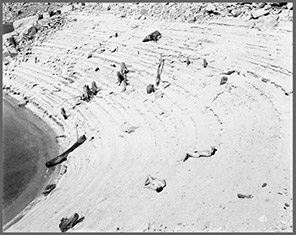
Sunbathers Beside Hetchy Hetchy Reservoir During a Drought, Philip Heying
Philip Heying also turns his attention to changing waterlines in “Sunbathers Beside Hetchy Hetchy Reservoir During a Drought.” In this black-and-white photo, two nude women lie on an incline of sandy earth angling down toward a reservoir that supplies drinking water to San Francisco. The women’s bodies blend into their surroundings as the curving lines of the dirt that mark the receding water draw your eyes from the uprooted tree trunks and rocks farther back into the scene.
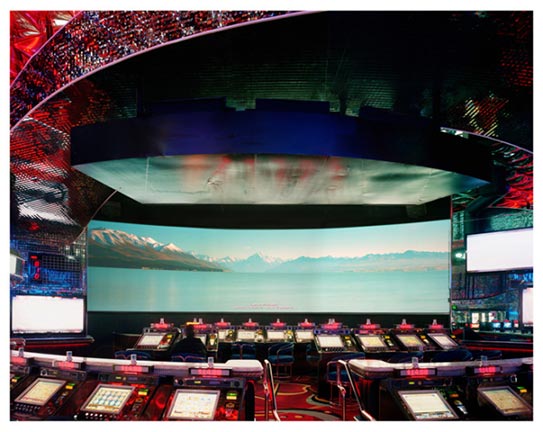
New Zealand’s Lake Pukaki, Joe Johnson
Joe Johnson contributes a landscape of sorts: a photograph of a photograph of a landscape (New Zealand’s Lake Pukaki), projected on a screen in a casino in Reno, Nevada. In stark contrast to the greenery of Sisemore’s photos, Johnson’s photo fits a simulated landscape inside something gaudy, man-made, mechanical. This isOverlook edging toward the surreal.
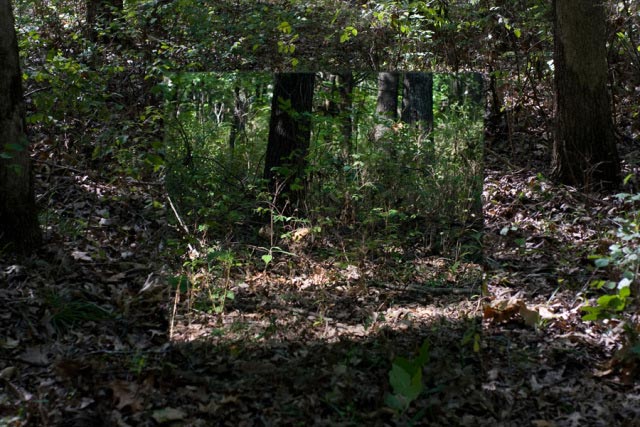
Reflection/Projection (I), Misha Kligman
Misha Kligman, known primarily as a painter, contributes two photos that also toy with perception. Their titles — “Reflection/Projection (I)” and”Reflection/Projection (II)” — are coolly scientific, but the images’ ethereal illumination and sylvan environs call to mind fairy tales. In one, a thin silver line bisects the composition, which is otherwise filled with dense brush and trees. In the other, a square area in the center appears lighterthan the surrounding greenery. The eerie radiance (achieved with mirrors?) is a memorable effect. Michael Boles’ “Spider Plant,” an image of a potted houseplant balanced on a slanted windowsill with the Stuart Hall Building visible through a grimy window in the background, is too plain.
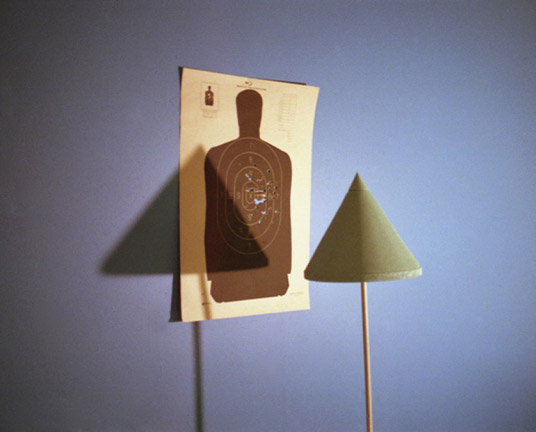
Target, Michael Boles More arresting is his “Target,” a photograph of a gun-range outline of a human form, riddled with bullet holes and hung on a wall painted solid gray. What appears to be a cone-shaped floor lamp casts an ominous shadow.
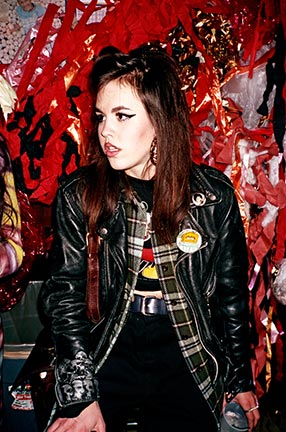
Shannon, Barrett Emke
Barrett Emke’s color-saturated portraits, “Shannon” and “Michael,” take us to some kind of party: Royals paraphernalia hangs in the background of the shots, and wood-paneled walls and shiny red streamers are also visible. The visual noise extends to the subjects’ elaborate attire. The young man in “Michael” is dressed in a velvet blazer, white face paint and a turquoise cross on a chain around his neck, and the woman in “Shannon” is decked out in thick black eyeliner and leopard-print hoop earrings. Both wear serene expressions, at home with — or unaware of — their surroundings. Lyles and Park have hung the portraits across from each other, a tease that forces you to wonder how they would appear side by side but allows “Michael” and “Shannon” to avoid each other’s gazes indefinitely as they avert their eyes from the picture plane.
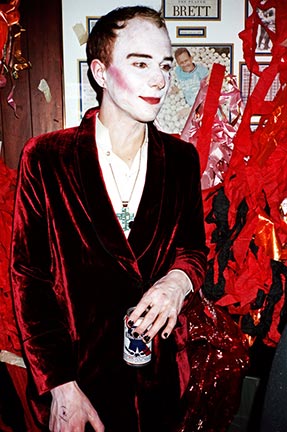
Michael, Barrett Emke
Overlook is as humble as exhibitions get these days. It features no apps, has no accompanying text, and comes down in another week without fanfare. But it’s also smartly put together, and a neat reminder
Overlook
Posted on October 1, 2012 by Andrew Lyles
A Group Photography Exhibition
Opening Friday October 5, 6:00-10:00pm.
Regular Hours: Tuesday-Friday 12:00-6:00pm & Saturday 12:00-3:00pm.
Exhibition Closes November 18, 2012.
Michael Boles -www.michaelboles.com
Barrett Emke - www.barrettemke.com
Philip Heying - www.philipheying.com
Joe Johnson - www.joejohnsonphoto.com
Misha Kligman - www.mishakligman.com
Kevin Sisemore - www.kevinsisemore.com
Covenant – Paintings and Drawings by Tyson Gough and Peter Granados
Posted on July 16, 2012 by Andrew Lyles
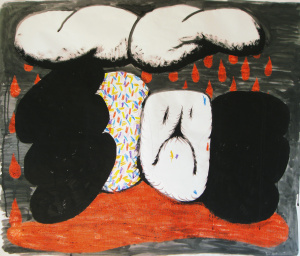
The object of every covenant is a type of redemption, real or perceived. However, the word almost instantly brings to mind popular cult activity and its associated harm: cryptic rites, kidnappings, abuse, and suicides. While the images in Covenant are at home among these grim results of belief, Covenant refers to the wager that these images make: that a subject morbid, absurd, and cartoonish in its drama can be felt as illumination or truth. Covenant’s pictures seek to make the senseless sense-able.
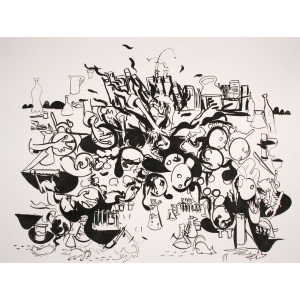
The magical implications of the word Covenant highlight the precarious nature of these tasks. To title the exhibition Covenant is to make a citation, to abuse the power of suggestion, and above all to extend an invitation.
- Tyson Gough and Peter Granados
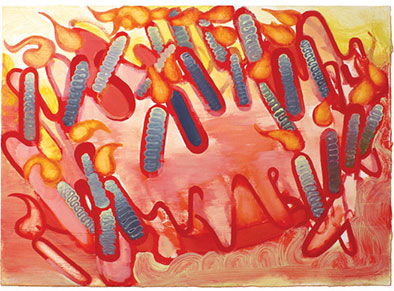
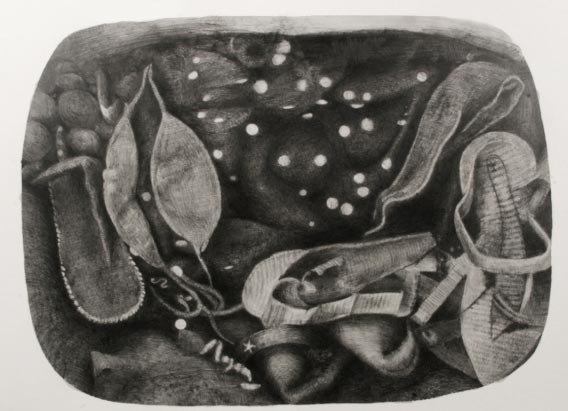
Exhibition: Neutral Space, Forteen Artist, Essay 1 of 2 by Neil Thrun
Posted on May 21, 2012 by Andrew Lyles
The essay Neutral Spaces, Empty Geometry examines a history of geometric art. Peter Halley’s anti-formalist theories are weighed against the revolutionary and political origin of geometric painting, Kazimir Malevich. Slovenian art collectives NSK, IRWIN and Laibach are compared to Peter Halley, and challenges are posited to contemporary artists here in Kansas City.
The essay is written in the strange space that many exhibition essays are written, that is, I have yet to see the show or any of the work within it. Instead of pretending knowledge or assuming authority about that work, I took it as an opportunity to examine a certain history suggested by the shows title, and to make predictions and challenges about that history.
Essay written by: Neil Thrun
Email: nthrun5000@gmail.com
Artist Exhibiting:
Amos Leager
Cambria Potter
Chris Bostick
Chris Daharsh
Emily Sall
Elliott Oliver
Francis A. Rivera Jr.
Katherine Anne Novotny
Kelly Clark
Kendra Werst
Lindsay Fernandez
Mike Erickson
Nicole Mauser
Sandra Bojanic
Todd Christiansen
Neutral Spaces, Empty Geometry: Why all artists need to re-engage with Ideology
“The formalist project in geometry is discredited. It no longer seems possible to explore form as form (in the shape of geometry), as it did to the Constructivists and Neo-Plasticists, nor to empty geometric form of its signifying function, as the Minimalists proposed.” –Peter Halley, The Crisis in Geometry (1984)
Today it is not the “formalist project of geometry” that is in crisis, but instead the deconstructive project of Peter Halley and other Neo-Geo Artists of the 1980s. Overturning what he saw as the history of 20th century abstract art, Halley argued that it “no longer seems possible to accept geometric form as either transcendental order, detached signifier, or as the basic gestalt of visual perception”. Halley’s essay instead critiques geometry in a Marxist methodology.
“The omnipresent unfolding of geometric structures in cities, factories, and schools, in housing, transportation, and hospitals, is revealed as a novel mechanism by which action and movement (and all behavior) could be channeled, measured, and normalized, and a means by which the unprecedented population of the emerging industrial era could be controlled and its productivity maximized”
And therefore:
“Based on this analysis, we may come to see in the work of these geometric transcendentalists a classicizing mechanism at work in which the very object of discomfort, geometry, is transformed into an object of adulation. In the formalists’ claim for geometry’s neutrality, we may likewise see an effort to normalize, to accept as given, the omnipresence of these geometric signs
And to rectify all of this Halley painted what he called “cells” and “conduits,” 1 that connected them. These geometric paintings were not abstract or neutral, but instead pictures of computer chips, prisons, factories, apartment complexes and city grids. His paintings were ethically and subjectively charged, a protest against modern society, a protest against the normalizing of the geometry of oppression.
Today it is not the “formalist project in geometry” that is floundering but instead Halley’s critique. In an ironic reversal Halley’s paintings have not changed in nearly 30 years beyond shifts in color, composition and texture; that is the only change has been a formal change. In addition, Halley has become nearly silent, having written very little since his essays of the 80s. And while the art world has embraced Halley, they have not embraced his critique. His paintings hang alongside minimalist works as if there were no conflict of ideology. His work is just as complicit in normalizing and classicizing the geometry of oppression as any work of Donald Judd, 2 or Josef Albers, 3

28 years after Halley wrote The Crisis in Geometry, our society has continued to structure and order itself geometrically; worker productivity is up while wages stagnate, cellular devices can track our movements and some are considering if internet access should be a Human Right. 28 years and I’m left wondering; was Halley’s intention revolutionary change (if so, he failed) or only a structural, formal analysis of our society and art?
Formal Revolutionary Geometric Art
Halley wasn’t the first geometric painter to embrace Marxist ideas. After the Russian Revolution of 1905 and before the February and October Revolutions of 1917, Kazimir Malevich painted Black Square and penned his manifesto From Cubism and Futurism to Suprematism: The New Realism in Painting. Malevich and his Suprematist movement are undoubtedly the origin of Halley’s “formalist project in geometry”, yet in his manifesto Malevich describes his Black Square,4 in both formal and revolutionary terms.
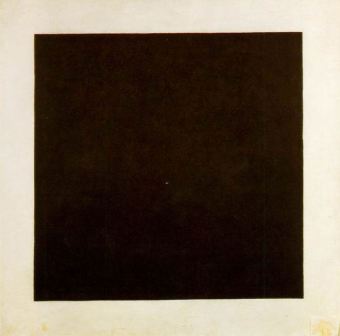
“The square is not a subconscious form. It is the creation of intuitive reason.
It is the face of the new art.
The square is a living, royal infant.
It is the first step of pure creation in art. Before it, there were naive deformities and copies of nature.
Our world of art has become new, non-objective, pure.”
The subject of his manifesto is not a formal set of rules, but a revolution within Art that would break with the art of the past.
“I have transformed myself in the zero of formand dragged myself out of the rubbish filled pool of Academic art.
I have destroyed the ring of the horizon and escaped from the circle of things, from the horizon-ring which confines the artist and the forms of nature.
This accursed ring, which opens up newer and newer prospects, leads the artist away, from the target of destruction.
And only a cowardly consciousness and meager creative powers in an artist are deceived by this fraud and base their art on the forms of nature, afraid of losing the foundation on which the savage and the academy have based their art.
Malevich saw his art, Suprematism, as a part of the revolutionary atmosphere of Russia in 1915. The Academy, and the Aristocracy that supported it, were also the “target of destruction” for the Bolsheviks. After the October Bolshevik Revolution of 1917, Lenin and Trotsky embraced Suprematism. Malevich was named to the head of different schools and institutes from 1917 until his death in 1935. Malevich’s geometric formalism became the art style of the revolution and was taken up by many of his students, who called themselves Constructivists and worked on state funded propaganda and architecture. El Lissitzky’s Beat the Whites with the Red Wedge, 5was one of the more famous propaganda posters of the October Revolution used the Suprematist/Constructivist language to symbolize the Reds, the Bolsheviks, beating the Whites, the coalition of loyalists and monarchists.
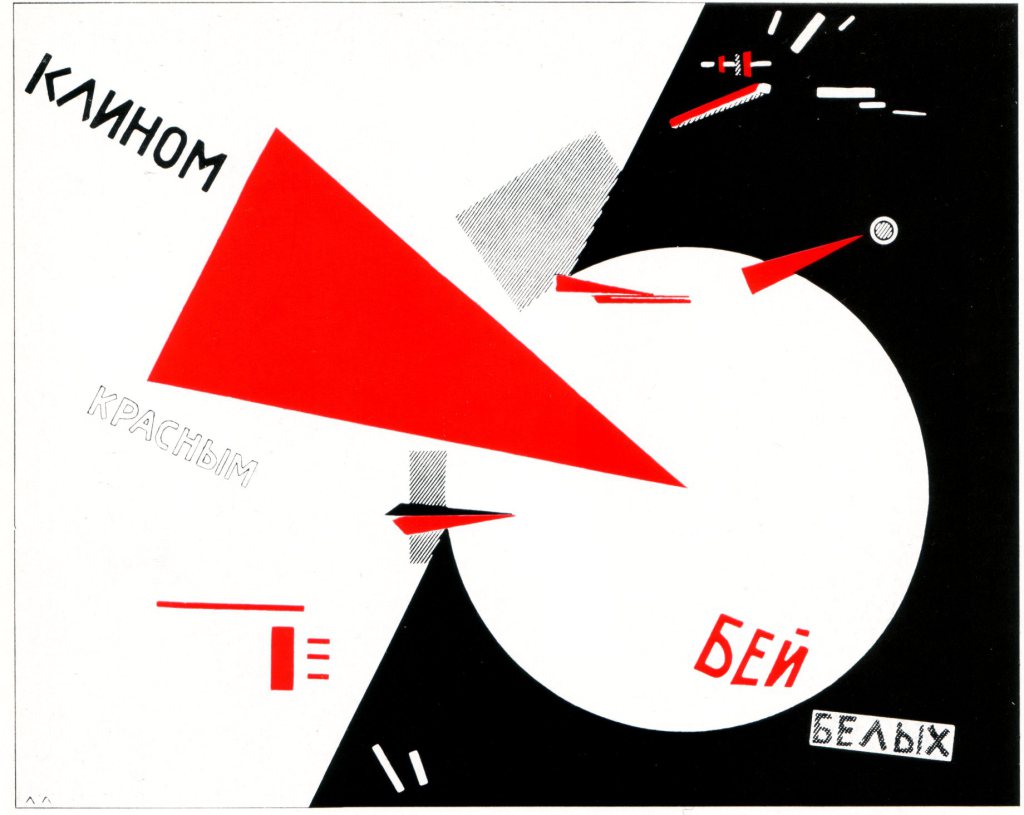
Yet this revolutionary art was short lived, in 1924 Lenin died and Stalin began consolidating his power, eventually becoming the sole ruler of the USSR by the end of the 1920s. By 1934, Socialist Realism became the official art style of the USSR and abstract art was banned. Socialist Realism with its heroic depiction of farmers, laborers, children and Soviet Leaders was better suited for propaganda (like Boris Vladimirski’s Roses for Stalin); 6

it was easier to understand and most importantly it did not encourage revolution. In Stalin’s prohibition of abstract art, we can see the refutation of Halley’s claim that the function of Constructivism was the normalizing and classicizing of oppression. If it was, Stalin surely would have used it in his methodical oppression of the USSR. Instead, its revolutionary character had to be stomped out, as its utopian dreams couldn’t match the reality of living in the USSR. In the most subtle sign of protest against Stalin’s prohibition, Malevich painted a self portrait in the Socialist Realist style, 7 but he signed the painting with a miniature Black Square instead of his signature.

Dissident Appropriations of Malevich
Malevich’s Suprematist Revolution was not forgotten, even if his work was banned and left in museum basements. In 1984 (the same year Halley wrote The Crisis in Geometry), dissident artists in Slovenia, then part of Yugoslavia and the USSR, formed the art collective Neue Slowenische Kunst (New Slovenian Art) or NSK. NSK members sought to bring to light repressed and censored histories within the USSR through art. Even the name NSK is a protest, by using a German name and acronym the artists of NSK were acknowledging Slovenia’s history as a state of the Austrian Empire. A group of NSK musicians named themselves Laibach; the name of Slovenia’s capital city of Ljubljana during the Nazi Occupation. This fascination with German and Nazi themes was not born out of sympathy for Fascism, instead the use of these historical names was to critique Soviet rule over Yugoslavia. By using Fascist imagery alongside Soviet imagery, NSK sought to show that the totalitarian principles of the USSR were no different than Nazi Germany. Even if Ljubljana was once again named Ljubljana, it was still not sovereign.
Considering NSK’s interest in the repressed history of the USSR, it is no surprise that Kazimir Malevich, a Ukrainian born citizen of the Russian Empire, would be of special interest to them. NSK chose Malevich’s Black Cross, 7 as their symbol, surrounding it with a circular toothed gear shape. 9 Whether or not this was a conscious move to link geometry and industry in the manner Halley theorizes is unclear, but NSK’s use of industry is definitely a critique of oppression. Laibach’s music was greatly inspired by the Industrial Music emerging out of Western Europe. Laibach combined the machine-like noises of bands like Throbbing Gristle with the marching beats and military anthems of the USSR. Unlike the Socialist Realist use of industry as a sense of patriotism or hard work, Laibach’s music is an anti-heroic parody of totalitarianism, in which both the Military and Industry are shown to be tools of state oppression.

When the USSR collapsed in 1992, a group of NSK painters, named IRWIN, travelled to Moscow’s Red Square to celebrate the event. Arriving at Red Square, IRWIN unrolled an enormous 22 meter black cloth square on top of Red Square. By bringing Malevich’s Black Square to the Red Square, 10 the heart of Soviet Government, IRWIN was trying to recapture the revolutionary schism that Malevich seized upon in 1915. This action was the inverse of Malevich’s 1933 Self Portrait where the black square was tiny and subordinate to Socialist Realism, in IRWIN’s action it is the black square that dominates the heart of the USSR. The documentary film Predictions of Fire shows IRWIN unrolling their black square amidst amused citizens and military police. When one officer is asked by the filmmaker about the black square the officer says “It is a painting of Malevich’s Black Square.” but then adds “But, of course, I don’t know what it means.”l

Neutral Spaces in Kansas City
“Politics is the highest and all-encompassing Art.
We create the New Slovenian Art.
We are Politicians.”
-Laibach, Manifesto (Undated, post 1990)
“In contrast to the false “anti-dogmatic spirit” which maintains a “critical distance” towards every theoretical enunciated in order to maintain the steady and full identity of its position of enunciation, it is the author’s conviction that only by unreservedly assuming a determinate theoretical position does one effectively expose oneself to possible criticism.”
-Slavoj Žižek, For they know not what they do: Enjoyment as a Political Factor (1991)
While this essay is written to accompany the exhibition, Neutral Spaces at the Spraybooth Gallery, it is written at an inopportune time. It was written before the exhibition, before the work was hung on the walls and even before the artists were selected. It is my expectation that the work in this exhibition will traverse the whole range of geometric art and that the intentions of the artists will vary between all the historical poles of geometric art.
More importantly, I expect the intentions of the artists will not be explicitly clear. I do not expect any dogmatic manifestos, written or painted, like those of Malevich, Halley or IRWIN. Unlike the history of the geometric art in Avant-garde, today no one in Kansas City seems interested in the ideology of their predecessors. No one has the arrogance or bombast to call their art a “royal infant.” While geometric art is not out of style, ideology and manifestos have not been taken up by artists in Kansas City. In this sense Neutral Spaces could just as easily refer to the mute apolitical vision of many Kansas City artists, just as easily as it could refer to the academic theories of Minimalism.
Today, the anonymous Russian officer’s quip about Malevich’s Black Square is truer than ever. We know Malevich, but who knows his sense of revolution? I can already see the counter-argument that the revolutionary character of Malevich, Halley and NSK were only possible because of their historical positions as the subjects of a totalitarian regimes (be it the Czar’s, Stalin’s or Donald Judd’s). Our state of affairs is different, but no less problematic. It is a distinct lack of authority that is our problem, our culture of Inpidualism has killed the will to be ideological (to take a stand). The reasoning of Inpidualism goes something like this: “We are all inpiduals; therefore we have no business telling each other what to do.” If Malevich’s “rubbish filled pool” was caused by the authoritarian control of the Academy whose standards were too strict and old-fashioned, then our rubbish filled pool has been created by complete permissiveness and lack of any standard. This is what Slavoj Zizek refers to as “anti-dogmatic spirit” and it is just as much an ideology as any other, the problem is that is has nothing to say beyond the criticism of dogmatic ideologies.
In Predictions of Fire, Slavoj Žižek says of NSK’s methods that “The only way to be really subversive is not to develop critical potentials or ironic distance, but to precisely take the system more seriously than it takes itself.” This is where I locate the failure of Peter Halley, 11 he has offered a critical potential and left it at that.
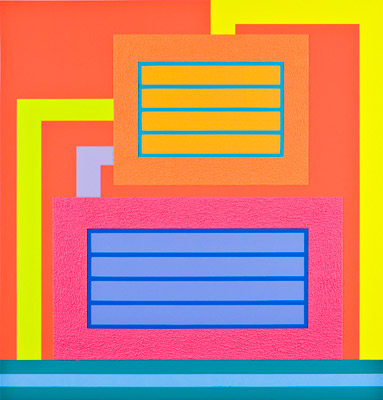
He hasn’t staked his own theoretical position on what geometric painting should or could do beyond his critique. If we want to “take the system more seriously than it takes itself”, we need to engage ideologically with and against our peers and do so more actively than Halley has. We should be willing to stand against methods of art making that we do not like, whether it’s faux-mysticism, academic formalism, banal interactivity or something else (these being things that I have no patience for, yours will presumably be different) but also take a stand for the art we do like. Only when we do this, will we “expose ourselves to possible criticism.” By being ideological, we can be more serious about inpidualism than inpidualism itself and we might actually be inpidual then. Otherwise we will be stuck making neutral spaces, work that is ideologically empty and without consequence, while drinking free alcohol and half-heartedly congratulating each other.
Artists need to re-engage with ideology and therefore each other. And this is true for not only geometric artists but all artists in general.
Essay written by: Neil Thrun
2011
Chase Aesthetic : Opening March 4th
Posted on February 28, 2011 by Andrew Lyles
Opening March 4th-26th, First Friday 5-9pm. Come one and all to the opening reception of the Spray Booth Gallery’s second exhibition “Chance Aesthetic: The Blotter Show!” Blotters, the sheets of paper used by printing studios for test prints, are typically …
The Kansas City Star!
Posted on February 25, 2011 by Andrew Lyles
Review | New Spray Booth Gallery exudes the energy of youth By THERESA BEMBNISTER Special to The Star The newly opened Spray Booth Gallery is an exciting, youthful addition to Kansas City’s cadre of do-it-yourself artist-run spaces. Occupying a back …
Opening of SBG with the show of: 6ix
Posted on February 25, 2011 by Andrew Lyles
6ix Kansas City, MO – The Spray Booth Gallery is celebrating its grand opening, with a group show featuring the work of – Paul Anthony Smith, Christina Dostaler, David Rhoads, Russell Shoemaker, Matt Jacobs, and Amanda Elise Bowles.

More Background On SprayBoothGallery.com
SprayBoothGallery.com served as the official online presence for Spray Booth Gallery, an artist-run exhibition space active in the early 2010s in the Crossroads Arts District of Kansas City. Though the gallery itself has since closed, its website and archived materials provide a rich window into a highly creative, collaborative moment in the city’s contemporary art scene.
This article explores the gallery’s origins, programming, cultural role, and lasting influence, offering a comprehensive look at what made Spray Booth Gallery a meaningful contributor to Kansas City’s artistic landscape.
Location and Cultural Context
Spray Booth Gallery operated in the Crossroads Arts District, a neighborhood widely recognized as the creative heart of Kansas City. Located near the intersection of 18th and Wyandotte Streets, the gallery was positioned within walking distance of numerous studios, exhibition spaces, and cultural institutions.
The Crossroads district itself rose to prominence in the late 1990s and 2000s as artists repurposed industrial buildings into studios and galleries. By the time Spray Booth opened, the area had become synonymous with First Friday art walks, where thousands of visitors would explore exhibitions, performances, and pop-up events across dozens of venues.
Within this environment, Spray Booth distinguished itself not by scale or commercial reach, but by its experimental ethos and independence.
Ownership and Organizational Structure
Spray Booth Gallery was not owned by a single commercial entity but instead functioned as an artist-run space, meaning it was operated by artists and curators rather than dealers or investors.
Key contributors included:
- Andrew Lyles (curatorial and organizational role)
- Collaborating curators and artists such as Erin Olm-Shipman, Tracy Abeln, and Sean Starowitz
This decentralized structure allowed the gallery to remain agile and open to diverse programming. Decisions were driven less by market demand and more by artistic inquiry and collaborative opportunity.
Importantly, the gallery’s programming was largely independent of revenue generation. This enabled organizers to take risks—showing work that might not have been commercially viable but was intellectually or culturally significant.
Mission and Philosophy
At its core, Spray Booth Gallery aimed to build a community around art-based experiences. Its philosophy emphasized:
- Supporting young and emerging artists
- Encouraging dialogue and experimentation
- Making contemporary art accessible and engaging
- Creating a space where artists could test ideas without institutional constraints
Rather than presenting polished, market-ready exhibitions, Spray Booth often showcased work that was exploratory, conceptual, and sometimes intentionally challenging.
This positioned the gallery as part of a broader movement of artist-run initiatives that sought to redefine how art spaces function, particularly outside major coastal art hubs.
Programming and Exhibitions
Monthly Exhibitions
Regular exhibitions formed the backbone of its programming, often featuring:
- Solo shows by emerging artists
- Group exhibitions organized around themes or concepts
- Experimental installations that transformed the physical space
Each exhibition was designed to reinvent the gallery environment, emphasizing spatial relationships, lighting, and viewer interaction.
Notable Exhibition: Molly Kaderka
One of the most documented exhibitions featured work by emerging artist Molly Kaderka.
Her shows, including In the Frame and Lovely Lonely, explored:
- Human relationships and emotional tension
- The interplay between figures and their environments
- Perceptual distortions in space and composition
Kaderka’s work exemplified the type of artist Spray Booth championed: technically skilled, conceptually driven, and unafraid to push boundaries.
Group Exhibitions
The gallery also hosted group shows such as photography exhibitions featuring regional artists. These shows often emphasized:
- Honest, observational approaches to image-making
- Diversity of style and subject matter
- Dialogue between works rather than a single curatorial narrative
Educational and Community Programming
Beyond exhibitions, Spray Booth Gallery invested heavily in educational and participatory programming.
Know Show Thursdays
One of its most innovative initiatives was “Know Show,” a series of short presentations where participants shared skills or ideas not typically taught in formal institutions.
These sessions:
- Featured multiple 15-minute presentations
- Encouraged peer-to-peer learning
- Were open to anyone interested in presenting or attending
This format reflected the gallery’s commitment to democratizing knowledge and fostering community engagement.
Artist Talks and Discussions
The gallery regularly hosted:
- Artist talks following exhibition openings
- Curator-led discussions
- Informal gatherings that encouraged audience interaction
These events helped bridge the gap between artists and viewers, making contemporary art more approachable.
Public Art and Collaborative Initiatives
Spray Booth Gallery extended its reach beyond its physical walls through:
- Public art initiatives
- Collaborations with other artist-run spaces across the United States
- Partnerships with arts publications and independent curators
These efforts positioned the gallery as part of a national network of grassroots art spaces, contributing to broader conversations about contemporary art.
Funding and Sustainability
Like many artist-run spaces, Spray Booth operated with limited financial resources. To support its programming, the gallery launched a Kickstarter campaign in 2012.
The campaign aimed to fund:
- Monthly exhibitions
- Thematic shows
- Collaborative exchanges with other spaces
The successful campaign demonstrated strong community support and underscored the value audiences placed on the gallery’s work.
Media Coverage and Recognition
While Spray Booth Gallery did not pursue mainstream commercial success, it did receive attention from local media outlets.
Publications such as The Kansas City Star highlighted the gallery as:
- A youthful and energetic addition to the local art scene
- A representative example of the DIY ethos in contemporary art
Additionally, The Pitch covered exhibitions and artists associated with the gallery, further amplifying its visibility.
Though it did not accumulate traditional awards, its recognition came in the form of critical engagement and community respect.
Audience and Community Impact
Spray Booth Gallery attracted a diverse audience, including:
- Local artists and students
- Art collectors interested in emerging work
- Members of the general public drawn to First Friday events
Its accessible programming and informal atmosphere made it particularly appealing to those who might feel intimidated by more traditional gallery settings.
By fostering dialogue and participation, the gallery played a role in:
- Strengthening Kansas City’s creative community
- Supporting the development of emerging artists
- Expanding public engagement with contemporary art
Aesthetic Approach and Spatial Awareness
One of the gallery’s defining features was its attention to spatial design and exhibition layout.
Installations were carefully arranged to:
- Guide viewer movement
- Highlight relationships between works
- Use lighting and negative space to enhance emotional impact
This approach aligned with broader trends in contemporary exhibition design, where the gallery itself becomes an active participant in the artistic experience.
Closure and Legacy
Spray Booth Gallery eventually closed, a fate shared by many artist-run spaces that rely on limited funding and volunteer labor.
However, its impact endures through:
- The artists it supported
- The ideas it helped circulate
- The community connections it fostered
Former participants and visitors often recall the gallery as a place of:
- Experimentation and risk-taking
- Collaboration and dialogue
- Genuine enthusiasm for art
Broader Cultural Significance
Spray Booth Gallery represents a broader phenomenon within the art world: the importance of independent, artist-run spaces.
Such spaces:
- Provide opportunities for artists outside commercial systems
- Encourage innovation and experimentation
- Serve as incubators for new ideas and practices
In cities like Kansas City, they play a crucial role in shaping local culture and connecting it to national and international conversations.
Comparison to Other Artist-Run Spaces
Spray Booth can be understood alongside similar initiatives across the U.S., particularly in cities with strong but decentralized art scenes.
Compared to larger institutions:
- It offered greater flexibility and risk-taking
- It operated with fewer resources but more creative freedom
- It prioritized community over commercial success
This model has become increasingly influential, especially as artists seek alternatives to traditional gallery systems.
Digital Presence and Website Functionality
SprayBoothGallery.com functioned as:
- A central hub for exhibition announcements
- A blog documenting events and artist features
- A platform for sharing essays and critical writing
The site reflected early 2010s web design trends, emphasizing:
- Simplicity and readability
- Frequent updates through blog-style posts
- Integration of text and images to document exhibitions
Though no longer active, archived versions of the site continue to serve as a valuable resource for understanding the gallery’s activities.
Spray Booth Gallery was more than just a physical space—it was a platform for experimentation, dialogue, and community-building within Kansas City’s art scene.
Through its commitment to emerging artists, innovative programming, and collaborative spirit, it exemplified the potential of artist-run spaces to shape cultural landscapes in meaningful ways.
While its doors have closed, its legacy persists in the artists it supported, the ideas it championed, and the community it helped cultivate. SprayBoothGallery.com remains an important archival record of that legacy, offering insight into a moment when creativity, independence, and collaboration defined a thriving corner of the contemporary art world.